The Academy
Eight courses to start.
49 short, practical lessons that fit around breakfast, each one drawn from a year of building and writing about AI. Start with AI Foundations, then take the courses that fit how you work. New courses land every month.

The tour
The Academy in 30 seconds
What you'll learn, how lessons fit around your morning, and everything that comes with membership.
The courses
Eight courses at a glance
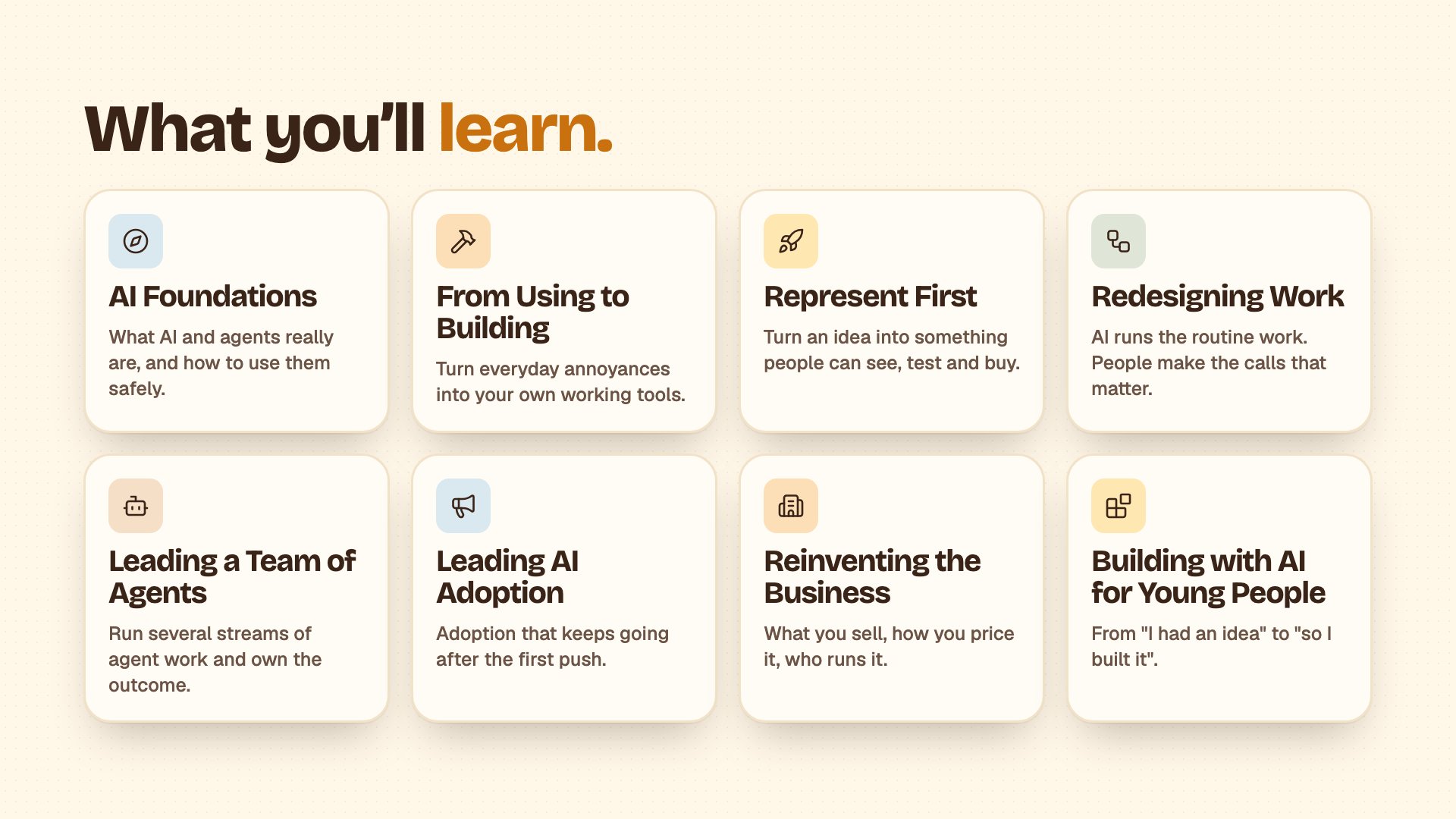
Start with AI Foundations, then pick the courses that fit how you work. Select a course to see every lesson.
AI Foundations
What AI and agents really are, how to brief them like a capable colleague, and how to use them safely.
6 lessons →
From Using to Building
How to turn everyday annoyances into your own working tools, built and online in an hour or two.
7 lessons →
Represent First
How to turn an idea into something people can see, test and buy, before anyone builds it properly.
5 lessons →
Redesigning Work from First Principles
How to redesign a workflow so AI runs the routine work and people make the calls that matter.
6 lessons →
Leading a Team of Agents
How to run several streams of agent work at once and own a whole outcome yourself.
6 lessons →
Leading AI Adoption
How to lead AI adoption so it keeps going after the first push, from culture and managers to hiring.
8 lessons →
Reinventing the Business
How AI changes what your business sells, how you price it, and who you need to run it.
8 lessons →
Building with AI for Young People
How to help a young person go from "I had an idea" to "so I built it" in four guided sessions.
3 lessons →
Course by course
What's in each course
AI Foundations
Thinking Clearly About AI
Most people meet AI as a chat box and decide what it is from there. This course starts somewhere more useful: the difference between asking a question and handing over an outcome. You'll learn what an agent actually does, how to brief one the way you'd brief a capable colleague, and why something that sounds human isn't. You'll treat AI as a partner you learn with rather than a vending machine. You'll also pick up the handful of habits that keep it safe: the least access it needs, approval before anything risky, and a record of what happened. Everything else in the Academy builds on this.
- Who it’s for
- Everyone, before anything else.
- You’ll come away with
- A clear picture of what AI and agents are and aren't, and the habits to brief and check them safely.
6 lessons
- 01
From answers to outcomes
Learn what changes when you stop asking AI questions and start handing it outcomes, and how an agent plans, acts and reports back like a project manager.
- 02
Briefing an agent
Brief an agent the way you'd brief a capable colleague: objective, constraints, preferences, deal breakers and outputs. Then use a nine-step blueprint to hand over any task, with checks along the way and a clear point to stop.
- 03
Mirrors, not minds
Why AI sounds human but isn't, how to stop going round in circles with it, and where plain, predictable rules should do the work instead.
- 04
Onboard it like a colleague
Give AI the context, feedback and patience you'd give a new starter, and judge it on how fast it learns, how quickly it works, the quality of its work and how well it adapts.
- 05
Learning with AI
Use AI as a learning partner, not a vending machine, so you understand the answer as well as get it. Simple prompts like "walk me through that" turn nerves into fluency.
- 06
Safe by method
The new risks when AI acts on your behalf, from convincing fakes to hidden instructions, and ten simple rules for using it safely at work. AI gives you a draft, not a decision.
From Using to Building
Personal Software on Demand
A day's training gets most people a ten to fifteen per cent lift, and then they stop. The bigger gain is on the other side of a wall: building with AI, not just using it. This course gets you over that wall. You'll learn to spot the small problems that were never worth solving before. You'll learn to describe the moment you're trying to fix rather than the technology, and to turn it into a working tool in an hour or two. Along the way you'll see eighteen real tools built this way, from a family budget tracker fed by bank texts to a currency converter built in a lift. You'll finish with one of your own, deployed and in use.
- Who it’s for
- Non-technical people ready for the second lift.
- You’ll come away with
- A working tool you built for your own problem, online and in use.
7 lessons and a capstone
- 01
The two lifts
Why using AI gives a quick 10–15% boost and then stalls, and how building with it gets you the second, bigger lift.
- 02
Personalised Software on Demand
Cheap building, cheap hosting and an audience of one mean software can now be made just for you. See how seventeen tools went from idea to everyday use in 34 hours.
- 03
Small things, at all
Find the small, everyday annoyances that were never worth fixing before, and see why they're now worth an hour of your morning.
- 04
Spec the moment, not the technology
Describe the moment you want to fix, not how to build it, and have the AI repeat its understanding back before it starts. Clear input, better tools.
- 05
The build method
A step-by-step method from first idea to something other people use, paced over four sessions: prototype, connect real data, put it online, then test and share it.
- 06
Find the data you're ignoring
Spot the useful data already landing on your phone, like bank texts, and turn it into a working tool, with a security check before you share it.
- 07
What makes a tool stick
What makes a tool you keep using: no friction, works offline, respects your attention, and helps you learn as well as get the job done.
Capstone
Build a tool for your own problem, put it online and use it for a week, with eighteen real build walkthroughs to borrow from.
Represent First
Prototyping and New Ventures
Ideas stall when they stay abstract, because a concept is hard to buy. This course is about getting an idea out of your head and into a form other people can see, question and act on, before anyone builds it properly. You'll use AI to sharpen a one-line idea into a clear proposition, rehearse the objections, and put up a landing page in an afternoon. You'll learn why high-fidelity prototypes are now as cheap as sketches, and how separate roles are merging into hybrid builders. You'll also see how one person can reach into marketing or sales without retraining. The question changes from "when will someone build this?" to "what can I show today?"
- Who it’s for
- Founders, product people and intrapreneurs.
- You’ll come away with
- An idea turned into something people can see, test and buy.
5 lessons
- 01
Represent before you build
People can't buy a concept. Learn a six-step method that takes an idea from one line to something people can see and react to, using the launch of this Academy, done in about two hours, as the worked example.
- 02
Speed is the resolution
High-fidelity prototypes now cost about the same as sketches. Learn to make them fast, and to get feedback on the idea rather than the button colours.
- 03
The great skill renegotiation
As designer, analyst and developer roles merge into hybrid builders, a small team can test five ideas in the time one used to take.
- 04
Reach into adjacent roles
How one person runs a full content operation for under $60 a month, and how to point the skills you already have at a new job.
- 05
Spark, don't replace
Use AI to generate and test ideas from what you've already written, while the writing itself stays yours.
Redesigning Work from First Principles
Most AI adoption adds a tool to the gaps in an old process and calls it transformation. This course starts from the other end: assume most tasks in a role can be automated, then ask what the job is now. You'll learn to choose between training the person, fixing the process, and removing the task altogether. You'll design workflows that run AI-to-AI by default, with people only at the gates that earn their place. And you'll test a redesigned team against the existing one before switching over. It finishes with the cost side. Tokens are the new hours, and the cheapest work is the work you've turned into a script.
- Who it’s for
- Managers, operations and process owners.
- You’ll come away with
- One real workflow, redesigned and tested against the old way.
6 lessons
- 01
Tasks, not jobs
AI will automate most of the tasks in a job, not most of the jobs. Learn to separate the human work from the work AI can run, and six moves to future-proof your role.
- 02
Fix the person, fix the process, or remove the task
Three questions to decide whether to train people, redesign the process or drop the task altogether, and a simple way to test before you scale.
- 03
AI-to-AI by default
Design workflows where AI hands work to AI and people step in only where they're truly needed: decisions you can't undo, accountability, real ambiguity or taste.
- 04
Contracts, not job descriptions
Define work by what goes in and what comes out, build an AI-first version of a team alongside the current one, and switch over only when it's proven.
- 05
The uncomfortable maths
If everyone gets faster, you can cut, grow or give time back. Why to choose openly, and why people fear silence more than they fear AI.
- 06
The token economy
AI is paid for by usage, so tokens are the new hours. Learn to send each task to the right model, turn repeat work into scripts, and keep costs down.
Leading a Team of Agents
Becoming a HALO
A HALO, or Human-Agent Led Operator, is one person backed by a team of agents and accountable for a whole outcome. This course is about becoming one. You'll learn to run several streams of agent work at once without losing track of the one that has stalled. You'll set the gates where your judgement is needed and stay out of the rest. And you'll direct agents with the precision they need: a clear definition of done, honest feedback, and standards that don't move. It closes on the question every HALO eventually faces: when the capability lives in your agents, who owns it?
- Who it’s for
- Practitioners who will run work through agents.
- You’ll come away with
- Several streams of agent work running at once, each with clear checkpoints and in plain view.
6 lessons
- 01
The HALO
What a Human-Agent Led Operator is: one person with a team of agents, accountable for a whole outcome. You don't have direct reports; you have direct outputs.
- 02
Octopusing
Run several streams of work at once and notice quickly when one needs you. The skill is switching cleanly between them, and some people in your organisation already have it.
- 03
Design for visibility
Set up one view of everything your agents are doing, read-only by default, so nothing stalls unseen.
- 04
Managing agents is not managing people
Agents need precision: a clear definition of done, honest feedback and standards that don't slip.
- 05
Delegated intent
Step in only when something is off, and know when to restart, abandon or escalate a piece of work.
- 06
Who owns the capability
When your agents hold the know-how, who owns it? What that means for your role, your employer and how you're paid.
Leading AI Adoption
The technology is ready; most organisations aren't, and that is a leadership problem. This course is for the people responsible for adoption. It explains why adoption so often surges after the first push and then fragments, and what stops that. The answer is leaders who go first, a clear reason for the change, honesty about what happens to jobs, and a culture built through small, visible wins rather than memos. You'll look at what HR becomes in an organisation built around systems rather than people, and what happens to managers. You'll see how hiring changes when skills can be learned in minutes. And you'll see how a Build Clinic turns a training day into lasting capability.
- Who it’s for
- Executives, HR and L&D.
- You’ll come away with
- An adoption plan that keeps going after the first push fades.
8 lessons
- 01
A leadership problem, not a technology one
Why adoption surges after the first push and then fragments, and how a clear purpose and honesty about jobs keep it moving.
- 02
Leaders go first
An organisation only goes as deep as its leaders do. Why the top team has to use AI themselves, and who should own it.
- 03
Culture through small wins
Get past the middle-management bottleneck with small, visible wins and a twice-weekly fast lane for decisions.
- 04
Built for systems, not people
What changes when work runs through systems as well as people: HR as the architect of culture, and team leaders becoming systems coaches.
- 05
Three managers, three fates
Builders, enablers and title-holders: which managers thrive, which don't, and why to reward depth of skill over the size of a team.
- 06
Hire for learning
When skills can be picked up in minutes, hire for how people learn. What to look for, the return of apprenticeships, and how to avoid age bias.
- 07
Make the second lift stick
Turn a single training day into lasting capability with Build Clinics: half-day sessions, one supervisor to five builders, on a regular rhythm.
- 08
Internal builders
Why you need your own builders again, who should own each internal tool, and why the model is not the product.
Reinventing the Business
AI doesn't just change how work gets done; it changes what a business sells. This course follows that change through: from tools to outcomes, from generic software to products shaped around one customer, from billing hours to pricing results. You'll see how a single founder can run departments made of agents, and why an organisation that never bought the big central system may now move fastest. You'll learn what it means to model how a business actually works rather than search its documents. It ends with the questions of ownership that follow when the process, not the finished piece, becomes the product.
- Who it’s for
- Founders, the C-suite and strategy.
- You’ll come away with
- One function to own end to end, and pricing that rewards results rather than hours.
8 lessons
- 01
The five stages of AI in business
Find where your business sits, from "sprinkle some AI in" to "AI just is", and why selling the outcome beats selling the tool.
- 02
Generic software is over
Why one-size-fits-all software is giving way to tools shaped around one customer at the moment they need them, and what that means for what you sell.
- 03
The end of time-based value
AI is dissolving the billable hour. Four ways to price instead: outcomes, judgement, access and services that compound over time.
- 04
The solo founder
How one person can run departments made of agents, bring in specialists for a mission, and grow without growing headcount.
- 05
The leapfrog
Why organisations that never built the big central system may now move fastest, and three routes to choose between.
- 06
Model the business
Move from searching documents to modelling how your business actually works, so it can ask its people for what it doesn't yet know.
- 07
Personalisation as architecture
Build around what customers want, not just what they click. Audit the customer journey and keep privacy built in from the start.
- 08
Protect the verb
When the process becomes the product, protect how you work: where outputs came from, digital twins of roles, and rules for owning a model.
Building with AI for Young People
Young people don't carry the hesitation about AI that many adults do: they expect to describe something and have it happen. This short course is for the parents and teachers who want to turn that into building. It uses real tools rather than children's apps. It starts from what the young person cares about and what annoys them. Then it works through a guided plan over four sessions, from a first prototype to something live on their phone. The aim is simple: "I had an idea" followed by "so I built it".
- Who it’s for
- Parents, teachers and young builders.
- You’ll come away with
- A real thing your young person has built and shipped.
3 lessons
- 01
Real tools, not toy ones
Children's AI apps hit a wall fast. Set up real tools safely, because the barrier is configuration, not intelligence.
- 02
Passion plus frustration
Start from what they love and what annoys them, generate twenty ideas, and narrow down to something they can finish this week.
- 03
The Four-Session Plan, guided
Four guided sessions from a first prototype to something live on their phone, including what to fake for now and what to make real later.